Research & Projects
Artist Research Practice
Tamara Friebel’s artistic research bridges embodied, multi-instrumental performance with architectural proportion, spatial acoustics, and philosophical inquiry. Drawing on her background in architecture, sociology, theology, and contemporary composition, her work investigates how lived intuition, resonant spaces, and visual geometry can be translated into detailed musical scores. Across orchestral, chamber, vocal, and interdisciplinary projects, she treats composition as a site-specific practice — constructing temporal architectures that immerse both performers and listeners.
Core Research Pillars
Generative Transcriptions
Originated during her doctoral research (Generative Transcriptions, an opera of the Self) and expanded across an eight-year tenure as post-doctoral researcher at the University of Graz, this methodology explores the direct translation of physical, improvisational sound into formal notation. By recording multi-layered acoustic improvisations across voice, strings, piano, bansuri flutes, horn and classical guitar — often emerging from focused, trance-like listening states — Friebel transcribes fleeting timbral gestures, microtonal inflections, and extended techniques into structured orchestral and chamber works.
→ Explore related works in the Catalogue
Architecture, Sacred Geometry & Spatial Acoustics
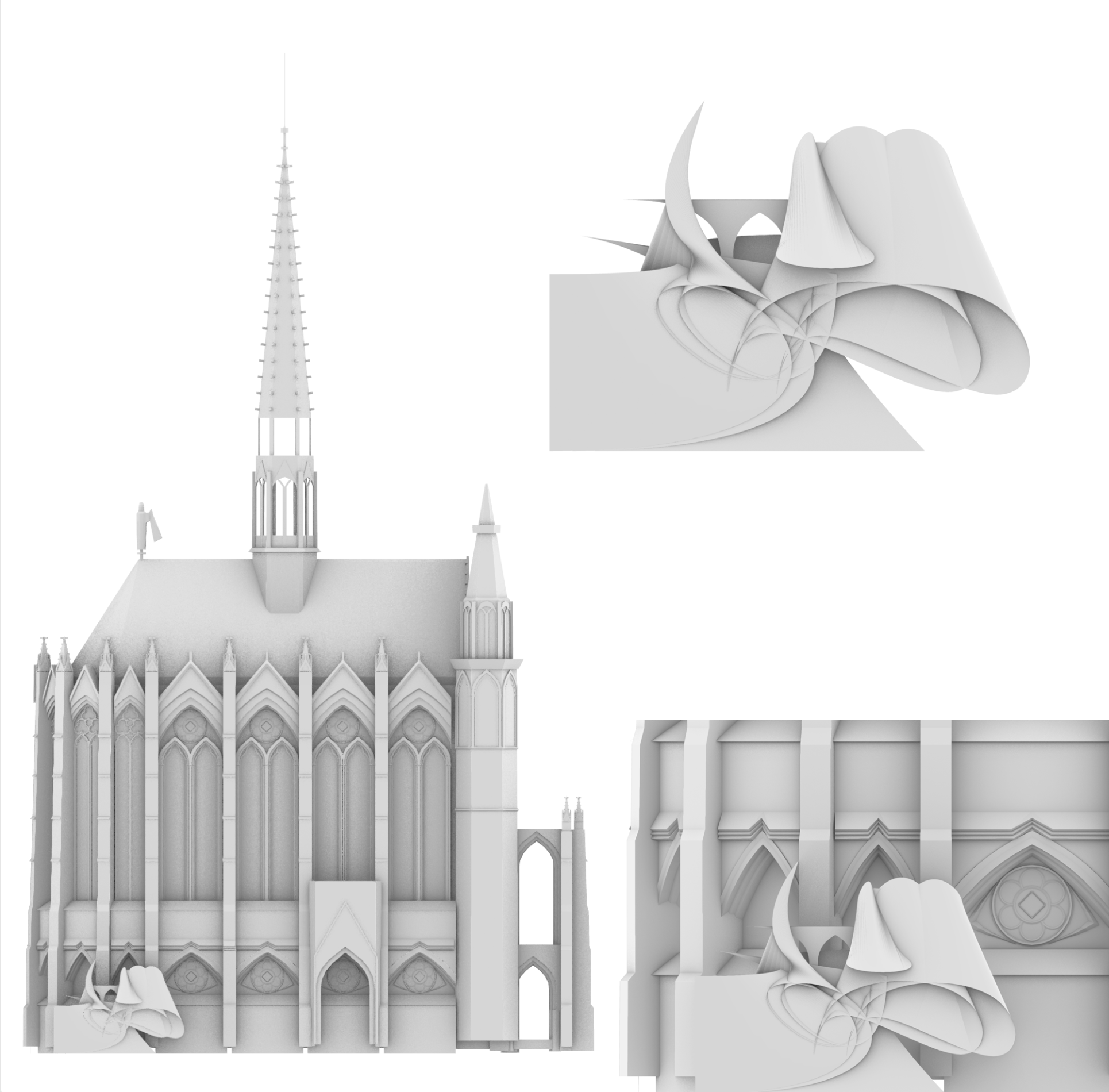
Building on her architectural studies in Melbourne and in Zaha Hadid’s masterclass at the University of Applied Arts Vienna (di’angewandte), Friebel investigates how spatial proportions, light and resonance govern musical time. Using 3D geometric modelling to map structural lines onto harmonic and rhythmic frameworks, she is currently composing a large-scale orchestral cycle translating iconic global architecture into sound—beginning with Aureola Lumina (inspired by Sainte-Chapelle in Paris) and continuing with a work modeled on Zaha Hadid’s Heydar Aliyev Centre in Baku.
→ Listen to Aureola Lumina (Excerpt)
Listen To Intuition (Interdisciplinary Arts & Mathematics)
Developed in collaboration with mathematicians at the University of Graz, Listen To Intuition examined the shared cognitive processes behind mathematical proof-building and musical composition. Through symposia, public broadcasts and artistic-scientific dialogue, the project investigates non-linera though patterns, creative insight and the role of intuition in rigorous formal systems.
→ Explore the Listen To Intuition Project→
Opera & Music Theatre Dramaturgy
Extending her compositional research into music theatre and opera, Friebel explores fragmented text, vocal nuance, and mythic or ecological narratives as structural engines for the stage. Her work in solo chamber opera includes Wärme \ Warmth—drawing on Japanese poetry and philosophical fragments to trace a movement from dissociation toward a re-weaving of meaning, with potential expansion into a stage worrk centered on Amaterasu—and Canto Morph, an Italian solo chamber opera that gathers fragments from Ada Negri’s poetry, curated through an acoustic reading attuned to phonetic nuance and sonic gesture rather than linear narrative. Looking toward broader stage and ensemble formates, her developing projects include family music theatre (Roxi, exploring themes of environmental care from a child’s perspective) and large-scale epic dramaturgy drawn from the Karna Parva of the Mahabharata.
Sacred Texts, Mysticism & Ancient Languages
In her choral and vocal writing, Friebel explores the acoustic resonance of ancient languages, poetic fragments and female mysticism as structural engines for contemporary soundscapes. Weaving Sanskrit mantras, invocations and contemplative texts into spatial polyphony, her recent works include the choral cycles Illuminations (engaging Hildegaard von Bingen and Rabi’a al-Adawiya) and Lotus, Offerotrium, alongside chamber settings of ancient Greek lyric poetry (Sappho Fragments).
→ Explore Choral & Vocal Works